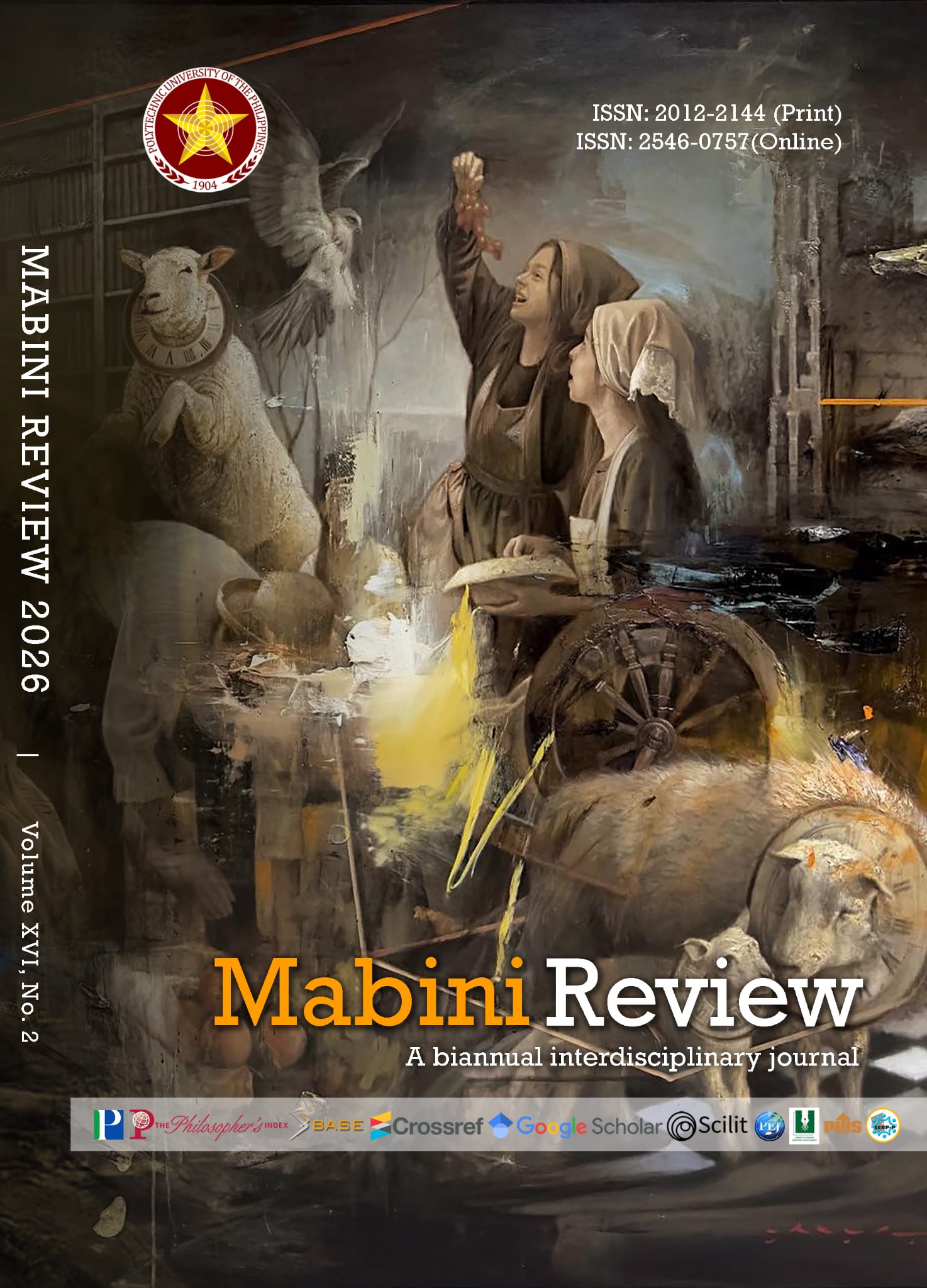
Volume 16, Number 2 (2026)
A Note from the Editor (Gerlie C. Ogatis)
The landscape of academic research is increasingly shifting toward localized perspectives, reflecting a growing optimism that contemporary scholars are becoming more invested in fostering a critical civic consciousness. This shift underscores the importance of engaging with and understanding the immediate social, cultural, and political contexts within which communities are situated. F.P.A. Demeterio III, in his study, Balik-Kilatis sa aking Pagsusulong ng Kritikal na Pilosopiyang Pilipino (Critical Retrospect on my Pursuit of Filipino Critical Philosophy) examines the lack of systematic and self-reflexive analysis in Filipino philosophy, particularly concerning the development, consolidation, and mainstreaming of Critical Filipino Philosophy. Rather than providing a general historical account, the study uses the author’s intellectual journey as a case study to demonstrate how critical philosophizing is practiced in the Philippine context. Ultimately, the study presents Balik-kilatis as a valuable contribution to the collective development of Critical Filipino Philosophy, allowing it to evolve into a living, sustainable, and transmissible intellectual tradition. Wilma M. Cruz and John Martin Diao, in their article, Dreamscapes from Recto Street: A Parallel Reading of Demeterio’s Partially Published Novel and the Highlights of His Works on Filipino Philosophy explore the intellectual relationship between Feorillo A. Demeterio III’s philosophical writings and his partially published novel, Dreamscapes from Recto Street. They examine Demeterio’s philosophical contributions, focusing on critical Filipino philosophy, the appropriation of foreign theories, intellectual historiography, cultural engagement, and the development of philosophical discourse in the Philippines. Their findings suggest that Dreamscapes from Recto Street serves as a literary extension of Demeterio’s philosophical project. In the end, the study demonstrates how literature and philosophy complement one another in articulating the complexities of Filipino identity and contemporary social realities. Rodrigo D. Abenes and Mary Irene Clare O. Deleña, in their manuscript, The Mabaquiao-Demeterio Debate: Assessing the Direction of Filipino Philosophy, assess the philosophical dialogue between Napoleon Mabaquiao Jr. and Feorillo A. Demeterio III during the 1st Union of Societies and Associations of Philosophy in the Philippines (USAPP), highlighting its significance in shaping contemporary Filipino Philosophy. Their exchange marks a shift from questions of existence toward concerns about philosophical identity, methodology, development, and practical application. The paper argues that their perspectives are complementary, as Mabaquiao reinforces disciplinary rigor while Demeterio broadens the social relevance and transformative potential of philosophical inquiry. Their dialogue reflects the growing maturity of Filipino Philosophy as it negotiates the relationship between global recognition and local realities, as well as academic professionalization and social engagement. Dominic B. Gonzales, his study on Slavoj Žižek and his Sublime Object of Ideology, emphasizes Žižek’s argument that ideology extends beyond a system of beliefs, functioning as a structural force that shapes human consciousness, desires, and understanding of existence. The author further highlights the paradoxical nature of resistance, arguing that attempts to overcome existing ideologies may result in the formation of new ideological systems rather than genuine liberation. The paper underscores the continuing relevance of Žižek’s critique in examining contemporary social realities, identity formation, and ideological practices. Jean Alchie T. Capacio, in her manuscript, Addressing the Bobotante Phenomenon: Towards Filipino Solidarity Through Rorty’s Irony, examines the bobotante phenomenon and its implications for democratic solidarity in the Philippines. The study challenges the tendency to label certain Filipino voters as irrational or unintelligent, arguing that such judgments reinforce elitism and undermine democratic unity. Drawing on Richard Rorty’s concept of irony, the study emphasizes the importance of recognizing the limitations and changing nature of individual beliefs and perspectives. It advocates for a more inclusive democratic culture grounded in empathy, humility, and open dialogue. Gabriel Joseph A. Barroso, in the study, Makibeki, ‘Wag Mashokot: Ang Pagrampa ng Grupong Bahaghari para sa Kanilang mga Karapatan (Makibeki, ‘Wag Mashokot: The Marching of LGBTQIA+ Group Bahaghari for Their Democratic Rights Makibeki), explores the history, objectives, and advocacy campaigns of Bahaghari as a progressive LGBTQIA+ organization in the Philippines. Through interviews with two organizational officials and an analysis of its official publications, the research explores the group’s contributions to advancing LGBTQIA+ rights and participation in social movements. Guided by Rowell Madula’s RAMPA theory, it highlights how members assert their identities and claim their rights through collective action. The findings emphasize that Bahaghari’s advocacies extend beyond gender equality, addressing broader social, political, and economic issues affecting various marginalized sectors of Philippine society. Lex Rei Brendon A. Hilario, Decluttering as Social Ecology: A Sustainable and Critical Response of the Self towards Ecological Issues from Capitalism, underscores decluttering as a micro-level praxis of social ecology, emphasizing its potential to challenge capitalist consumerism and promote environmental sustainability. Drawing on Murray Bookchin’s social ecology, the study explores the relationship between society, nature, hierarchy, and the capitalist imperative of continuous production and consumption. It argues that intentionally reducing personal possessions reflects a critical shift in attitudes toward material ownership and excessive consumption. Through practices such as decluttering and bartering, individuals can resist unsustainable consumption patterns, encourage communal ecological responsibility, and contribute to the development of a more sustainable and socially conscious society. Daryll G. Pugal , The Limits of Logic in Social Analysis: A Reply to Pariñas, critiques Noel S. Pariñas’ argument on inclusion and exclusion, particularly his analysis of Republic Act No. 9262 or the Anti-Violence Against Women and Children Act. It argues that interpreting social inclusion solely through syllogistic logic and exclusionary positivism overlooks the complexities of social realities. The study identifies the limitations of reducing social issues to mutually exclusive logical propositions and proposes an alternative approach grounded in ordinary language philosophy, particularly performative utterances and speech act theory. Ultimately, it emphasizes examining laws through their social meanings and contributions to justice, equality, and inclusion. Jomar D. Redubla, Revisiting Dewey’s Philosophy in the Context of the MATATAG Curriculum, examines the relevance of John Dewey’s progressive educational philosophy to the Philippine MATATAG Curriculum, focusing on experiential learning, democratic pedagogy, and learner-centered education. Through qualitative document analysis, it identifies significant alignment between Dewey’s educational principles and the curriculum’s emphasis on inquiry-based learning, contextualized instruction, and holistic development. However, challenges such as inadequate teacher preparation, unequal resource distribution, and standardized assessment hinder their effective implementation. The study emphasizes the need for sustained teacher development, equitable educational resources, experiential learning opportunities, and formative assessment to strengthen progressive education and promote critical thinking in Philippine basic education. John A. Amtalao , On the Discourse of Indigenous Capital and Cultural Commodification in Media and Performance, examines the commodification of Indigenous Filipino culture in media, highlighting how traditional practices, rituals, and cultural expressions are reduced to marketable symbols. Drawing on Pierre Bourdieu’s theory of capital, it explores how media representations reinforce social hierarchies and influence cultural recognition and power. The study proposes Indigenous capital as a fifth form of capital, emphasizing the inherent cultural, historical, spiritual, and symbolic value of Indigenous traditions. It argues that Indigenous communities should be recognized beyond their commercial representation, acknowledging their distinct identities, worldviews, and cultural significance while challenging misrepresentation and superficial portrayals in mainstream media. Shirley Palileo, Semiological Discourse Analysis of Image Order and Functional Dialectics in Bernal’s 1980 Film, Manila by Night, analyzes Ishmael Bernal’s Manila by Night (1980) through semiological and critical approaches, examining how cinematic elements such as mise-en-scène, sound, and montage communicate historical and ideological meanings. It highlights how religious imagery, spatial arrangements, and musical motifs expose underlying power relations and social contradictions during authoritarian rule. The study also considers the influence of censorship on the film’s narrative and historical reception. Ultimately, it demonstrates how Philippine popular cinema uses representations of morality and modernity to critique social realities and reveal the ideological structures shaping Filipino society under authoritarian governance. Andaman S. Aliman, Jr., The Rise of AI-Capitalism: Rethinking Marx’s General Intellect in the Age of Machinic Automation, examines Marx’s concept of the “general intellect” and its relationship with artificial intelligence under contemporary capitalism. It argues that capitalism transforms collective human knowledge into measurable data to accelerate automation and reduce dependence on human labor. Drawing on Marx and Dyer-Witheford et al., the study highlights how AI increasingly positions workers as supervisors of automated processes rather than active producers. It further contends that this technological development reflects the underlying conflict between labor and capital. Ultimately, the paper argues that AI-driven automation threatens human life activity and weakens individuals’ recognition of their identity as species- beings. Nolly Chris P. Lopez, Comprehensive Sexuality Education in the Philippines: An Evidentialist Critique, analyzes the necessity, effectiveness, and ethical implications of implementing Comprehensive Sexuality Education (CSE) nationwide in response to teenage pregnancy in the Philippines. Focusing on the Adolescent Pregnancy Bill (SB 1979), it evaluates changes in the bill’s provisions and the influence of cultural relevance and contextual appropriateness on CSE implementation. Through an examination of DepEd learning materials and existing evidence, the study investigates whether CSE effectively addresses adolescent pregnancy and whether its educational framework is pragmatically and ethically justifiable. It also critically examines sensitive issues concerning childhood sexuality, including masturbation and gender identity, in relation to children’s rights and educational responsibilities. On behalf of the Editorial Board of the Mabini Review Journal, we are pleased to present Volume 16, Issue No. 2. We extend our sincere appreciation to our contributing authors and valued readers for their continued support. It is our privilege to share this latest collection of scholarly works, and we hope that it offers meaningful insights and engaging perspectives. We wish everyone an enriching and enjoyable reading experience.Articles
Dreamscapes from Recto Street: A Parallel Reading of Demeterio’s Partially Published Novel and the Highlights of His Works on Filipino Philosophy
Wilma Cruz and John Martin Diao
The Mabaquiao-Demeterio Debate: Assessing the Direction of Filipino Philosophy
Rodrigo Abenes and Mary Irene Clare Deleña
Giving to the Other as a Way of Philosophy of Dialogue:With AI Communicating BARMM with the World
Jaime Del Rosario, Ninio Sagucom, and James Edison Andaya
Slavoj Žižek and his SUBLIME OBJECT OF IDEOLOGY
Dominic Gonzales
ADDRESSING THE BOBOTANTE PHENOMENON: TOWARDS FILIPINO SOLIDARITY THROUGH RORTY’S IRONY
Jean Alchie Capacio
Makibeki, ‘Wag Mashokot: Ang Pagrampa ng Grupong Bahaghari para sa Kanilang mga Karapatan
Gabriel Joseph Barroso
Decluttering as Social Ecology A Sustainable and Critical Response of the Self towards Ecological Issues from Capitalism
Lex Rei Brendon Hilario
The Limits of Logic in Social Analysis: A Reply to Pariñas
Jethro Daryll Pugal
On the Discourse of Indigenous Capital and Cultural Commodification in Media and Performance
John Amtalao
SEMIOLOGICAL DISCOURSE ANALYSIS OF IMAGE ORDER AND FUNCTIONAL DIALECTICS IN BERNAL’S 1980 FILM, MANILA BY NIGHT
Shirley Palileo