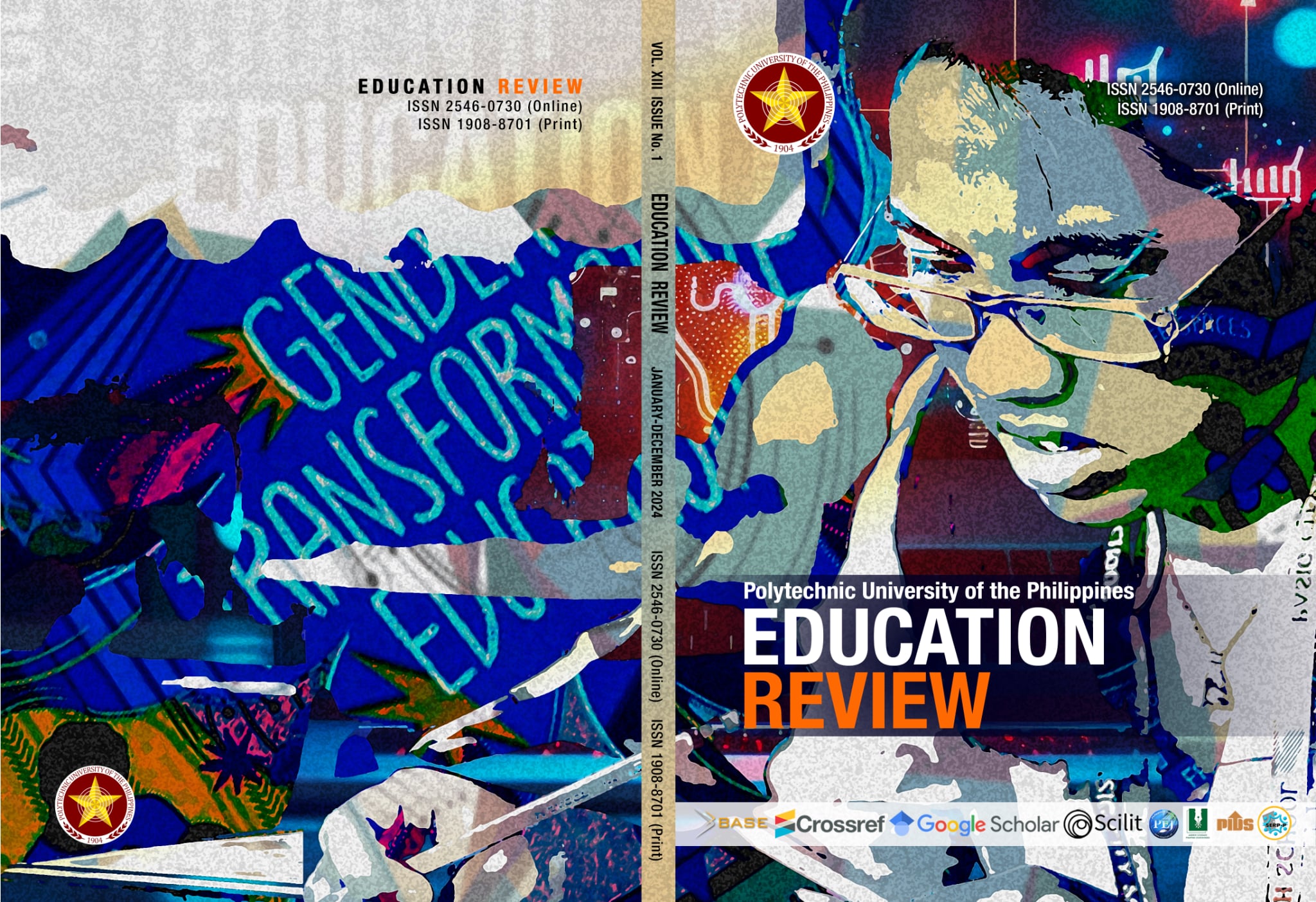
Transformative Pathways in the 21st Century: Leadership, Innovation, and Empowerment in the Philippines
Striving for academic excellence in the 21st century surpasses educational outcomes as it necessitates transformative leadership and innovative approaches in teaching and learning to empower individuals and communities. As educational institutions bridge the gaps in technological advancements, manpower requirements, and teaching and learning, research plays a critical role in identifying evidence-based strategies that promote significant and lasting change. Consequently, contemporary educational research has shifted in identifying transformational approaches that strengthen institutional communities to respond effectively to multifaceted situations. The studies featured in Volume XIV, Issue 1 of the PUP Education Review collectively demonstrate how the three thematic pillars – leadership, innovation, and empowerment intersect to address educational and societal challenges in the Philippines. The first thematic pillar of this journal issue is leadership. Effective leadership is one of the most widely recognized catalysts of educational improvement, particularly in responding to the country’s continuing learning challenges. The study on principal instructional leadership underscores the importance of protecting instructional time as an important factor in enhancing teacher effectiveness towards improved instructional leadership while prioritizing 21st century skills development. Complementing this perspective is the investigation of Appreciative Inquiry (AI) in administrative management, which exemplifies how a strengths-based leadership framework can improve cultivate collaboration, organizational commitment, and continuous institutional improvement. These studies reinforce transformative leadership as an avenue to cultivate an environment where students, teachers, and administrators can thrive. The second thematic pillar focuses on innovation as a catalyst to quality education and dynamic teaching-learning process. Digital transformation has been a global phenomenon which significantly reshaped classroom settings. Despite its positive effects on the 21st century classroom, it continuously faces issues in terms of integration in day-to-day learning process. The study of Nurturing Engagement and Lifelong Learning through Audio-Visual (NELLA) Program demonstrates the effectiveness of customized multimedia instructional materials through increased engagement among learners, targeted instruction, and self-paced learning. This suggests that digital transformation serves as a valuable pedagogical tool in enhancing knowledge retention and comprehension among learners. Similarly, Project SPARTA – a national initiative that offers data analytics training through Massive Open Online Courses (MOOCs) highlights the importance of skill-specific outcomes to improve self-efficacy among professionals. Further, these online courses become key tools to improve one’s ability to build knowledge and skills. These studies contribute to innovation that is beyond technological adoption, because educational innovation involves designing learner-centered experiences that eventually respond to the changing needs of society. Empowerment is the third thematic pillar of this volume. It recognizes education as a powerful instrument for personal development, economic mobility, and social inclusion. In the Philippines, the Technical Education and Skills Development Authority (TESDA) and the Department of Social Welfare and Development (DSWD) collaborate with Local Government Units (LGUs), Non-Government Organizations (NGOs) and other government bureaus to provide skill training to low-income individuals. The narratives of completers of the Community Skills Development Program (CSDP) highlight the achievement of combatting poverty by enhancing their knowledge, skills and attitudes to increase their employability, productivity and capacity. CSDP – a sustainable and cost-effective program thus help achieve long-term socioeconomic benefits and allow people to develop and upgrade their skills to adapt to the challenges of the globalization. Meanwhile, the study on contraceptive use among educationally marginalized women highlights the importance of access to information on contraception usage improve the decision-making among marginalized women to become knowledgeable and responsible women in their households and societies. Together, findings of these studies prove that empowerment is achieved when individuals are provided with combined knowledge, skills, and opportunities which are necessary to shape their own futures. Collectively, the articles published in this issue advocate for an educational ecosystem that embraces transformative leadership which oversees innovation for inclusive learning and prioritizes the empowerment of individuals and communities. These remind us that educational transformation is not confined in the four corners of academic institutions as it extends to families, communities, and workplaces where learning continues to shape the lives and societal progress of individuals. The PUP Education Review Board is grateful to all the authors, contributors, reviewers, and editors for making this journal issue possible. We hope that the articles presented in this issue will inspire our colleagues, educators, researchers, educational leaders, and policymakers to pursue transformative pathways in advancing educational excellence, while fostering innovation and inclusive development.Qualitative and Quantitative Studies
Relationship Between Principal Instructional Leadership and Students' 21st Century Skills Performance on the National Achievement Test (NAT)
Mark – Jhon R. Prestoza and Niño D. Naldoza
A 4D Analysis of Appreciative Inquiry:
Evaluating its Applicability and Effectiveness
in BVS Colleges’ Administrative Management
Sheillo D. De La Cruz
Narratives of the Community Skills Development Program Completers in District 1, Makati
Soliel Samson and Jonathan Florida
The Influence of Data Analytics MOOCs in Making Career Decisions: The Case of Project SPARTA Completers
Nikko Visperas, Donna Pamella Gonzales, Alan Cajes, Mary Therese Fernandez, Ragella Phoebe Terrado, and Jerby Lopez
Contraceptive Use and Intention Among Educationally Marginalized Women in the Philippines: Evidence
Mejedin R. Tena, Jedidia Eunice P. Peña, and Manolito R. Tangan Jr.