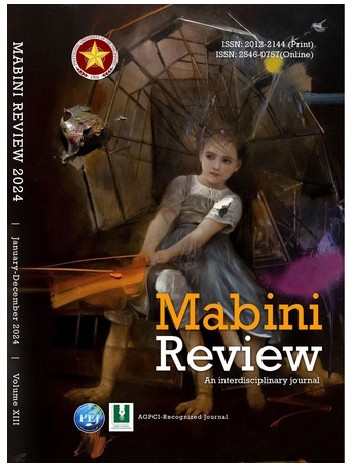
Volume 13, Number 1 ()
DECOLONIZATION VIS-À-VIS THE CULTIVATION OF A LOCALIZED EPISTEMOLOGY (GERLIE CASPE-OGATIS)
Filipino scholars are now becoming cognizant of giving due importance to a more localized epistemic analysis, an attempt to move away from the shackles of Western thought that dominated the themes of academic research for quite some time. This endeavor creates a hopeful tone, because it is a way of paying respect to the authenticity of experience of our very own people, a fidelity to one’s identity. The 2024 issue of Mabini Review Journal is a presentation of a rich scholarship in ethnography by virtue of the authors’ careful scrutiny of the intricacies of our tradition and culture. Needless to say, it is a glimpse to a more decolonized set of philosophical and social studies. DR. F.P.A. DEMETERIO III contributed a study on the Philosophical Thoughts of Vajiravudh: A Dialogical Analysis from the Perspective of Critical Filipino Philosophy. In this study, the author succeeded in presenting a well-crafted philosophical analysis on the ideas of a genius Thai thinker, Vajiravudh (1881-1925), or King Rama VI of Siam. He further explored the philosophy of the latter by using the point of view of critical Filipino philosophy that can be traced back to the musings of the late 19th century Filipino propagandists. In essence, his paper looked into Vajiravudh’s thoughts on nationalism and identity, the Chinese and Muslim minorities, modernization and international relations, politics, gender, and family, as well as on his use of literature in philosophizing. Demeterio’s contribution in this journal issue will benefit, in great deal, scholars who are likewise interested in venturing into a philosophical analysis of Southeast Asian philosophy, an area that is oftentimes sidelined due to the supremacy of Westen philosophical influences. This conscious step to showcase the rich scholarship in Asian thought runs congenial with our attempt to build a deeper understanding of our Filipino philosophy as well. JEREMIAH JULIAN MONTEJO in his manuscript, Ang Unang Sigaw ng Himagsikan: Isang Pagsusuring Aklat sa The Cry of Balintawak: A Contrived Controversy ni Soledad Borromeo-Buehler, presented a good exposition of the events that took place during the commencement of the Filipino uprising against the Spaniards who ruled and controlled the Philippines as a colony for more than 300 years. For him, despite being a significant historical event, controversies regarding when and where the first cry of revolution took place continue to remain unresolved. To this day, researchers and historians continue to debate and exchange views on this issue. This historical concern became a stormy and heated topic in the academic circle particularly from the historians’ side, when Teodoro Agoncillo proposed the idea of the Cry at Pugad Lawin on August 23, 1896, as the correct date and location of the first cry of the revolution, contradicting some of the earlier historical claims that it happened on August 26 in Balintawak. Thus, this study presents a credible scholarship of a historical fact that will benefit the readers in great deal, historians and non-historians alike. RIZALINO NOBLE MALABED in his manuscript, A Reign of Fear and Anxiety: Martial Law’s Roots in Colonialism, examined and challenged our commonplace understanding of martial law as Marcos Martial Law. Central to its analysis is finding out whether martial law can be considered a law, while at the same time looking for a deeper analysis on how we make sense of the then assertion that martial law was a democratic self-defense. The author highlighted three important concerns in this essay; first, it demonstrates the connections between the terms that define martial law: exception/emergency, doubled rule of law, arbitrary power, and violence/terror. Then, it illustrates the continuities in the logic and repertoire of martial law whether deployed within the colonial and post-colonial. Lastly, it shows that martial law is not just Marcos Sr.’s, but also Arroyo’s and Duterte’s, also Anglo-American and European colonialisms’—stained with an inequitable history, a depraved logic, and a repertoire of brutality. This study, therefore gives its readers an alternative way of analyzing the concept of martial law, a way of paying respect as well to our not-so distant experience of it. JONATHAN JAMES O. CANETE and LESLIE ANNE L. LIWANAG contributed a study concerning a Filipino behavior that appears to be of fatalistic tendency when challenged by hardship due to experiences of poverty and a meager mode of survival. Through their article, A Phenomenological Reflection on Ubos-Biyaya and Petsa de Peligro: Capitalism’s Impact on Filipino Attitude of Spending and Church’s Proposition for an Inclusive Economy, the authors used a phenomenological analysis that delves into the intertwined concepts of “ubos biyaya” and “petsa de peligro” in the socioeconomic landscape of the Filipino society. Ubos-biyaya, a Filipino term, encompasses the state of having depleted both tangible and intangible resources. Petsa de Peligro, translating to “day of danger,” signifies the period before payday when financial constraints intensify. The authors explored in this paper the correlation of ubos-biyaya and capitalism, which leads to the feeling and experience of petsa de peligro, elucidating how the latter emerges as a consequence of the former. It connects ubos-biyaya to planned obsolescence and the cathedrals of consumption, revealing how these systemic paradigms contribute to resource depletion and economic constraints. The authors emphasized in this study a critical evaluation of prevailing paradigms, urging a transition towards inclusive economic frameworks that prioritize sustainability, equitable resource allocation, and social cohesion. REYNELE BREN ZAFRA and JEZNIN ANGEKYLA BARROQUILLO in their study Tungo sa Intelektuwalisasyon ng Wikang Pambansa: Isang Panayam kay Dr. Fortunato B. Sevilla III ukol sa Potensiyal ng Filipino bilang Wika ng mga Siyentipikong Talakayan, emphasized the importance of popularizing the use of Filipino language in a scientific and mass-oriented discourse. Familiarity with its context will always benefit the general masses in understanding social issues and pressing concerns that will aid them in weaving a better way of survival. This call for use of Filipino language in intellectual and common discourse was advanced by Dr. Fortunato Sevilla III of UST, who even came to point of utilizing our own language in teaching a specialized course in physical science, like chemistry. This helps a lot in advancing a call to popularize the use of our own language in intellectual dialogues, that can be extended in the natural and physical sciences. PRINCESS GISSEL DIONELA-SERVO and LHERIS MAY OPLE featured in their manuscript, Panimulang Pag-aaral sa Visual Framing: Sipat-suri sa mga Piling YouTube Vlogs ni JT ng MoTouristas sa Kaniyang Misyon na Libot Pilipinas, the undertakings of Filipino motorcycle riders who took courage to travel in different cities and municipalities in the Philippines. The study particularly focused on the featured vlogs of a particular motorist famously known as Juan Turismo or JT, where he was able to capture the interests of his followers due to a realistic and interesting presentation of different places, he was able to visit for the past two years. Vlogging becomes an important spectacle for the Filipino community to appreciate the beauty of our country’s culture and its people. The archipelagic nature of our land makes it doubly hard to reach different destinations, with the recent development in the vlogging industry, YouTube was helpful enough to showcase the countryside, which in the past, was not easy to gain knowledge about. NICHOLSON M. NIDEA and VASIL A. VICTORIA contributed a study showcasing the creative means of survival of our very own people in an article with the title, Naratibo sa Pagtitiklad: Paglikha at Paglalarawan sa Pagkakakilanlang Calabangueño. This study focused on the description and narration of the cultural attributes inherent in a community, aiming to provide new insights to enhance understanding and identification of ethnographic issues and occupational language varieties, particularly in the municipality of Calabanga, Camarines Sur, through day-to-day pagtitiklad activities. The culture of a given society encompasses the customary practices, behaviors, and beliefs shared by a collective group. As an ethnographic study, it gives value to the promotion of a localized type of knowledge by capturing real experiences of people and the protection of a tradition that becomes inherently important in preserving their unique culture. JOHANNE RANDOLF ANDRADA, BRENDAN CARLOS and DOMINIC GONZALES presented a study on language, with the title, Noam Chomsky on Ludwig Wittgenstein: A Contemporary Critique of the Concept of Language Privatization. The authors underscore the philosophical conundrums as to whether language carries a universal meaning (logocentrism) on the one hand, or whether it can be best understood in its contextual use as exemplified by ordinary language. What is at stake in this study is the question of whether there can be a private language, of which the camp of Wittgenstein emphatically denied there can possibly be one. This debate reverberates the present problematic that language philosophers wish to unravel further. BLESSING GARCIA-GLOVA and her study on the Leadership of Local Chief Executives in the Philippines: A Literature Review, disclosed the hardships of local leaders in managing their political responsibilities during the COVID-19 pandemic. The author emphasized the importance of the role of local political leaders because their actions shape the outcome of citizens’ condition considering their knowledge and familiarity of the localities that they manage. Moreso, this familiarity with the communities aids the local leaders in addressing the challenges in aspects of poverty, stability and peace, and employment, among others. This gives an edge in crafting a potentially successful pandemic response strategies and the efficiency of the employed method so that they can easily extend help to their respective constituents. Through systematic literature review, this study attempted to make an evaluation on the notion of leadership and the Philippine local leadership literature, with emphasis on the Municipal Mayors specifically factoring in the challenges that they faced during the pandemic. AXLE CHRISTIEN TUGANO contributed an essay in this scholarly compendium, Saysay ng Dogs in Philippine History sa Multidisiplinaryong Pag-aaral ng Kasaysayan at Lipunang Pilipino, with a careful analysis of the symbiotic relationship between nature and man. The author presented in his essay the positive trait of Filipino people as respectful of nature, clearly manifested in their manner of extending love and compassion to animals. This essay traced this good attribute of our people historically, showing that many of written manuscripts in the past exhibited stories of Filipinos as truly pet lovers in general. To our dear readers, I hope you will find an inspiration and reconsider giving value to our very own localized knowledge. It is because the beauty and dynamics of the Filipino culture and tradition was being carefully crafted in the pages of this particular journal issue. Indeed, it is my pride and honor to present to you, PUP Mabini Review Journal Volume XIII, 2024 Issue!Articles
The Philosophical Thoughts of Vajiravudh: A Dialogical Analysis from the Perspective of Critical Filipino Philosophy
FPA Demeterio III
Ang Unang Sigaw ng Himagsikan: Isang Pagsusuring aklat sa The Cry of Balintawak: A Contrived Controversy ni Soledad Borromeo-Buehler
Jeremiah Julian Montejo
A reign of fear and anxiety”: Martial law’s roots in colonialism
Rizalino Noble Malabed
A Phenomenological Reflection on Ubos-Biyaya and Petsa de Peligro: Capitalism’s Impact on Filipino Attitude of Spending and Church’s Proposition for an Inclusive Economy
Jonathan James O. Canete and Leslie Anne L. Liwanag
Tungo sa Intelektuwalisasyon ng Wikang Pambansa: Isang Panayam kay Dr. Fortunato B. Sevilla III ukol sa Potensiyal ng Filipino bilang Wika ng mga Siyentipikong Talakayan
Reynele Bren Zafra and Jeznin Angekyla Barroquillo
Panimulang Pag-aaral sa Visual Framing: Sipat-suri sa mga piling YouTube Vlogs ni JT ng MoTouristas sa kaniyang misyon na Libot Pilipinas
Princess Gissel Dionela Servo and Lheris May Ople
Naratibo sa Pagtitiklad: Paglikha at Paglalarawan sa Pagkakakilanlang Calabangueño
Nicholson M. Nidea and Vasil A. Victoria
Noam Chomsky on Ludwig Wittgenstein: A Contemporary Critique of the Concept of Language Privatization
Johanne Randolf Andrada, Brendan Carlos, and Dominic Gonzales
Leadership of Local Chief Executives in the Philippines: A Literature Review
Blessing Garcia Glova