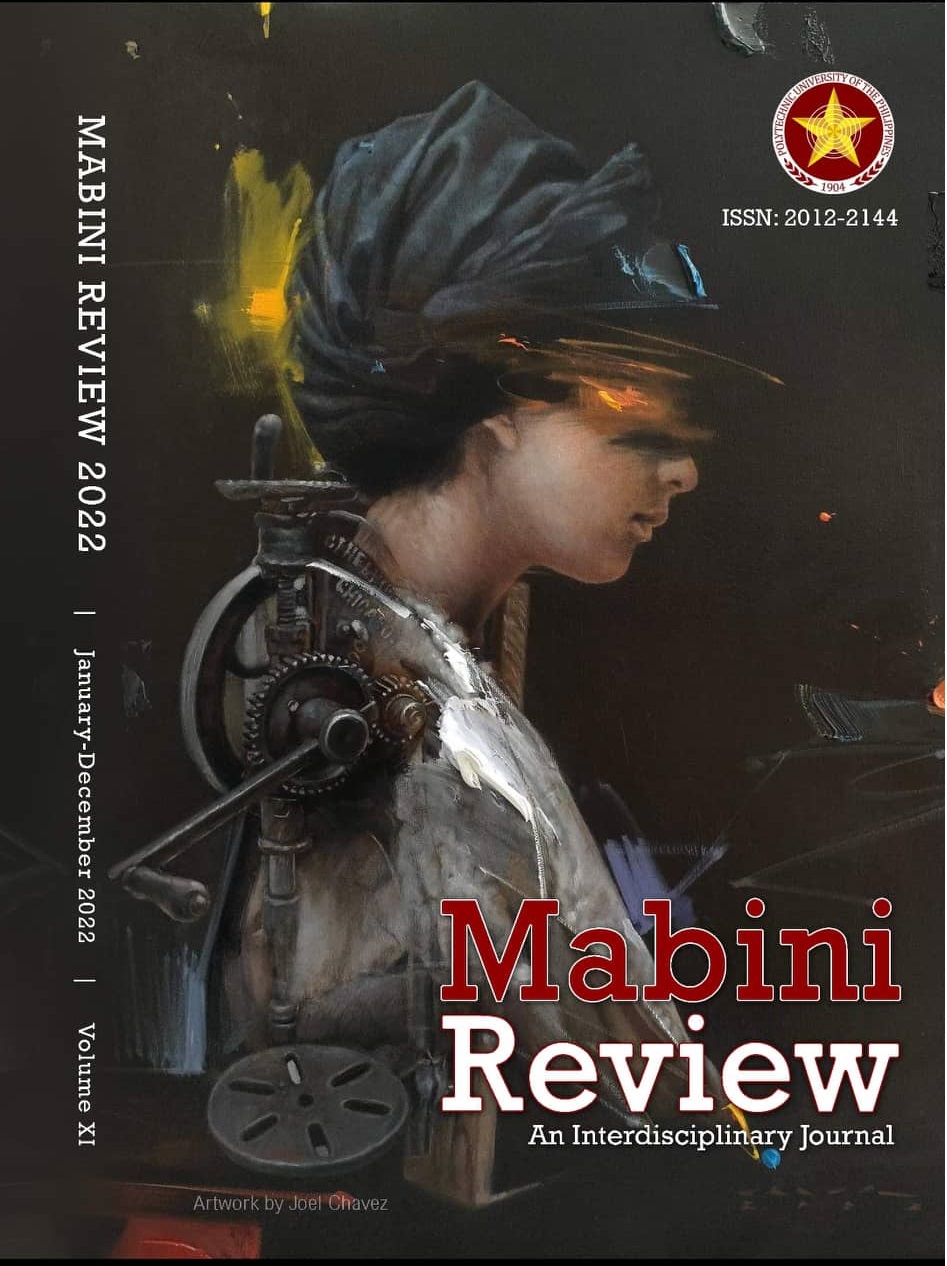
Volume 11, Number 1 (2026)
Critical Analysis in the Context of Self-Referentiality (Gerlie Caspe-Ogatis)
The critical spirit of our authors and their dedication to put back their fidelity in rediscovering the richness of our own culture was the highlight of our 2022 issue of Mabini Review Journal. One can sense the ember of overflowing scholarship in our featured manuscripts. Our contributors are truly sympathetic of the need to establish a critical stance as a contribution to the growing culture of research, and their critical attitude is reminiscent of what the philosophers referred to as ‘self-referential’ exposition of truth. In this sense, the validity of their claims is anchored on a form of reality that they actively engage in, their scholarship is not devoid from experience. Our authors heeded the call to throw away the ladder and stop writing from the tower, they realistically analyze things from the ground. It is of great pride that I am tasked to present the content of Mabini Review Journal 2022 issue. As we continue to fulfill our promise of offering rich literature in our featured manuscripts, this issue sets the bar higher in terms of exceptional presentation of concepts and ideas from our authors. When the Greeks pronounced justice as being excellent in one’s craft dubbed as aretḗ, our authors best exemplified this virtue in this volume of the journal vis-à-vis the formation of realistic and philosophical research outputs that are truly representational of social issues that we observe in our time. In the manuscript featured from a renowned author, E. San Juan Jr., titled Commodity Fetishism and the Crisis of Contemporary Arts, he patiently elaborated the problematic reality confronting Contemporary Art at present, that it was inserted in the capitalist mode of commodification losing its true essence of serving an aesthetic end devoid of materialism. To borrow the author’s term, he described the present as a ‘catastrophic period of triumphalist globalism paving its way to the formation of materialist aesthetics described by the author as anachronistic and a kind of perverse joke’. It is indeed antithetical to the aesthetic tradition laid down by Kant, that arts must serve its purpose well without the intrusion or a form of control from the observer. Its telos is attuned to the realization of human freedom, and our appreciation of the beautiful must be a result of the free play of human imagination, and one should not put concern over the material value attached to a given work of art. Dr. Maria Eliza P. Cruz and her manuscript, The Growing Dissonance between the Kosmos and the Anthropos: A Hermeneutic Study of the Mechanistic World View brought by Einstein’s Relativity Theory and Heisenberg’s Indeterminacy Principle in Quantum Physics, made an attempt to bring back the essence of scientific endeavor as not purely mechanistic because it is in fact representational of our attempt to understand human life in general. A potential mutuality in the field of interest between science and philosophy is discussed in great detail, an admirable exposition of the author’s view that the limit of science is tied to its human dimension, after all, a scientific inquiry is a product of human rationality. As such, all attempts to dehumanize scientific inquiry is given a new twist by the author in this study by presenting rich analysis justifying the need to bring forth the human dimension in our understanding of the natural world. The manuscript of Mariefe Cruz, Ang Naging Makaldag na Lakbayin: Isang Pagsipat sa Ilang Mahahalagang Yugto sa Kasaysayan ng Kritikal na Pamimilosopiyang Filipino, is an exposition of the challenges faced by Filipino philosophers to critically examine the social setting they are immersed into. The author painstakingly traced the history of the formation of critical philosophy and included the contributions of our own Filipino scholars in the development of the discourse. She then concluded that it remained a challenging task at present to our Filipino Philosophers to remain true to what is expected from them, and that is their capacity to form critical assessment of the social realities despite the limits they may encounter set by socio-political conditions in our land. Another Gramscian manuscript is presented by Artchill Fernandez with the title, Durkheim Revisited, Possible Contribution to the Understanding of Gramsci’s Notion of Hegemony. The author explored the possibility of using Durkheim to understand the notion of hegemony by building a potential link between the two thinkers’ contention of consent-generation that may lead to social solidarity and collective action. Other point of convergence was also highlighted, like for instance, how the thinkers conceptualized the state and civil society, it showed a promising similarity that may help sociologists to take advantage of this exposition instead of promoting rivalries of competing theories. A socio-cultural manuscript is presented by Princess Gissel DionelaServo in her contribution in this journal’s particular issue, Ang Prusisyon Tuwing Semana Santa sa Lungsod ng San Pablo City, bilang Assemblage. The author took a serious attempt to understand the importance of this religious tradition by working closely with people who have done major contributions in making the assemblage an eventual success. A study of this nature plays a relevant role in our recognition of our rich Filipino culture, especially in analyzing the value of religiosity as it becomes a venue in forming solidarity among those people who are involved in this type of social activity. After all, our attempt to find answer to the question as why we should uphold religious beliefs could add up to our assessment of our individual role in preserving a dynamic Filipino society. Fr. Jaime D. Del Rosario presented his research focusing on a possible convergence of Christian and Muslim viewpoint in lieu of their respective religious practices. His manuscript, Muslim-Christian Goodness of Life as a Philosophical Perspective, is a critical valuation of the similar goodness that these two views of religiosity maintain, by using Emmanuel Levinas philosophy, the author presented a deep analysis of the blending of the Muslim and Christian notions of goodness of life. His inspiration streamed from his personal experiences as a philosophy teacher in the Mindanao area who has likewise given a privilege position to encounter students belonging to these two religious practices, leading him to conduct a study exposing the view that we all have this potential tendency to weave a similar notion of the good life, irrespective of our religious beliefs or affiliations. I hope the readers of Mabini Review Journal 2022 will find it inspiring that our manuscripts in this particular issue are products of our authors critical reflections of their own experiences, making the validity of their analyses a product of self-referential assessment of their own realities.Articles
Commodity Fetishism and the Crisis of Contemporary Art
E. San Juan Jr.
Durkheim Revisited: Possible Contribution to the Understanding of Gramsci’s Notion of Hegemony
Artchil Fernandez
Ang Prusisyon Tuwing Semana Santa sa Lungsod ng San Pablo City, bilang Assemblage (The Holy Week Procession in San Pablo City as an Assemblage)
Princess Gissel Dionela- Servo
Muslim-Christian Goodness of Life as a Philosophical Perspective
Fr. Jaime Del Rosario